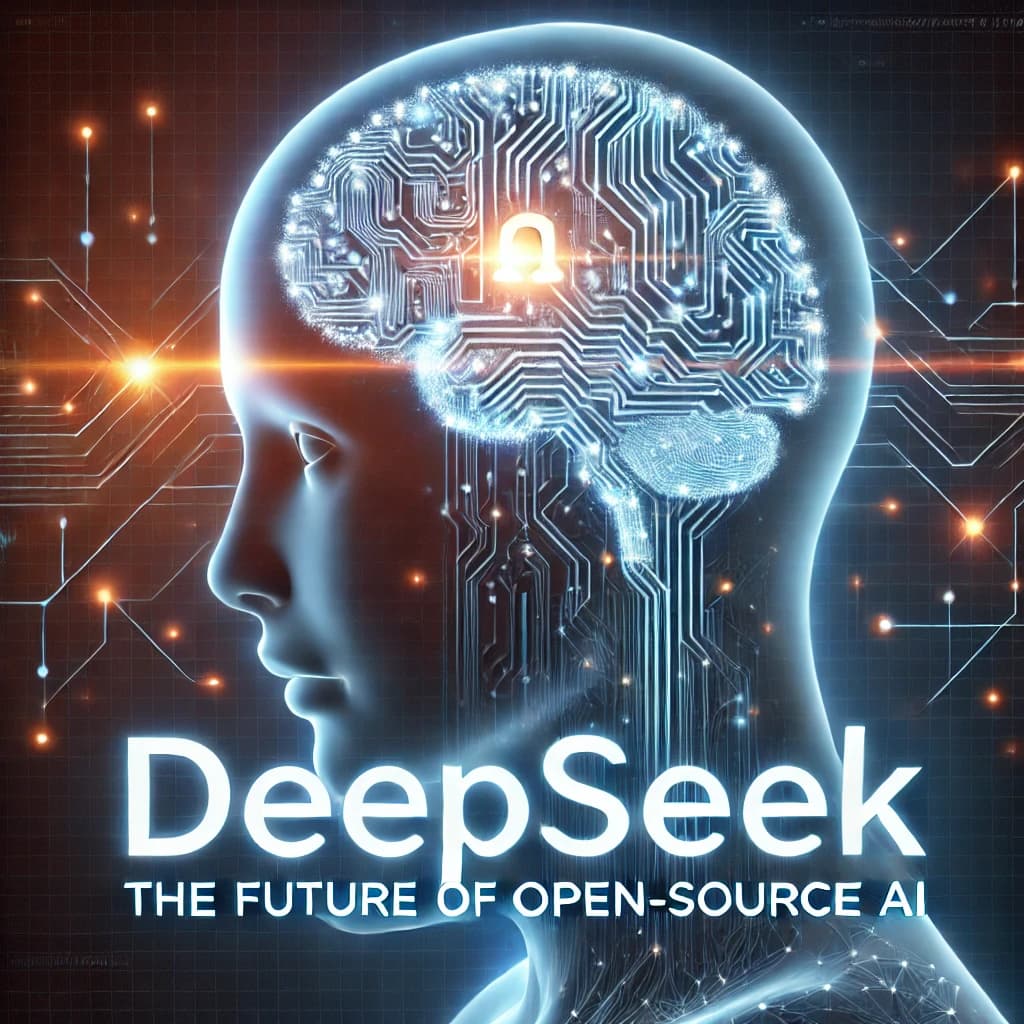
DeepSeek: The Future of Open-Source AI
BY Ima Appweb ON January 29, 2025
In the ever-evolving world of artificial intelligence, DeepSeek has emerged as a game-changer. As a Chinese AI company focused on developing open-source large language models (LLMs), DeepSeek is paving the way for more accessible and efficient AI solutions. The company’s commitment to innovation and transparency has made it a key player in the AI industry, challenging the dominance of proprietary models.
What is the Big Deal About DeepSeek?
DeepSeek is not just another AI company—it represents a fundamental shift in how artificial intelligence is developed and shared. Unlike closed-source models controlled by major tech firms, DeepSeek’s open-source approach allows developers worldwide to access, modify, and improve upon its AI models. This fosters innovation and makes AI technology more inclusive and cost-effective.
DeepSeek also challenges the notion that powerful AI models require vast computational resources. By optimizing training methods and leveraging efficient architectures, DeepSeek has achieved state-of-the-art performance at a fraction of the cost of competitors like OpenAI and Google.
Who Founded DeepSeek?
DeepSeek was founded by Liang Wenfeng, a prominent figure in China’s AI industry. With extensive experience in artificial intelligence and machine learning, Wenfeng’s vision was to create an affordable and accessible AI ecosystem that could compete with Western tech giants. Under his leadership, DeepSeek has rapidly gained traction as a major player in the global AI race.
Why DeepSeek is a Game-Changer
One of the most significant aspects of DeepSeek is its focus on efficiency and cost-effectiveness. Traditional AI models require vast amounts of computational power and financial resources. However, DeepSeek has developed a more streamlined training process that reduces costs while maintaining high performance.
Additionally, DeepSeek’s models have been optimized for complex reasoning tasks, such as mathematics, coding, and logical problem-solving. This makes them highly valuable for industries ranging from education to software development.

What Are the Challenges for AI Giants?
The rise of DeepSeek presents significant challenges for established AI leaders like OpenAI, Google, and Meta. These companies rely heavily on proprietary models, which require massive financial investments and specialized hardware, often making them inaccessible to smaller developers and businesses.
DeepSeek’s open-source model disrupts this paradigm, allowing anyone to build and innovate without high costs. This forces AI giants to reconsider their strategies, as the demand for more affordable and customizable AI solutions grows.
Moreover, regulatory scrutiny and ethical concerns surrounding AI development continue to mount. Companies like OpenAI and Google must navigate increasing pressure to ensure transparency, data privacy, and responsible AI usage—areas where DeepSeek’s open-source approach provides a competitive advantage.
Why is the Global AI Market Spooked?
The emergence of DeepSeek has sent shockwaves through the global AI market. Investors and tech companies are closely watching as this Chinese AI powerhouse challenges the dominance of Western firms.
Several factors contribute to this market uncertainty:
- Cost Disruption – DeepSeek’s ability to train powerful AI models at a fraction of the cost threatens the profitability of existing AI giants.
- Geopolitical Tensions – The rise of Chinese AI firms raises concerns about technological competition and national security.
- Market Shifts – Businesses and developers now have access to high-quality, open-source alternatives, reducing reliance on expensive AI subscriptions.
These factors have led to stock price fluctuations in major AI companies, as investors reassess the competitive landscape in the wake of DeepSeek’s rapid growth.
How Businesses Can Benefit from DeepSeek
For businesses looking to integrate AI into their operations, DeepSeek offers an exciting opportunity. Whether it’s improving customer interactions, automating workflows, or enhancing data analysis, DeepSeek’s open-source LLMs provide flexible and cost-effective solutions.
Moreover, companies that adopt DeepSeek’s technology gain a competitive edge by leveraging AI-driven insights and automation. With the ability to customize models to fit specific needs, businesses can harness the power of AI without being locked into proprietary systems.
Looking Ahead: The Future of DeepSeek
As DeepSeek continues to grow, its influence in the AI industry will only expand. With ongoing research and development, the company is expected to introduce even more advanced models, further pushing the boundaries of what AI can achieve.
The success of DeepSeek also underscores the importance of open-source collaboration in shaping the future of artificial intelligence. By prioritizing accessibility and efficiency, DeepSeek is setting a new standard for AI development worldwide.
Why You Should Pay Attention to DeepSeek
The AI revolution is here, and DeepSeek is leading the charge. With its commitment to open-source AI, cost-efficient models, and groundbreaking research, DeepSeek is redefining the way businesses and developers approach artificial intelligence.
If you’re looking to explore the potential of AI for your business or project, now is the time to get involved. Visit IMA-APPWEB to learn more about how DeepSeek and other AI innovations can transform your digital strategy.
Frequently Asked Questions About The Future of Open-Source AI
1. What is DeepSeek AI, and how does it work?
DeepSeek AI is an artificial intelligence company from China that develops large language models capable of understanding and generating human language. Its models can assist with writing, coding, reasoning, research, and problem-solving. DeepSeek provides model weights for several releases, allowing developers to explore, customize, and deploy AI solutions under applicable licensing terms.
2. Why is DeepSeek important for the future of open-source AI?
DeepSeek is significant because its AI models have demonstrated that advanced language-model capabilities can be developed with an emphasis on computational efficiency and accessibility. Its model releases give developers and researchers opportunities to experiment, customize applications, and investigate alternative approaches to AI development, potentially broadening participation in the AI ecosystem.
3. Is DeepSeek AI free to use?
DeepSeek offers access to certain AI models and services without requiring payment for every use case, although availability and pricing depend on the product. Developers may download supported model weights for local deployment under their respective licenses. API usage, infrastructure, hardware, and commercial deployment can involve additional costs and conditions.
4. How is DeepSeek different from ChatGPT?
DeepSeek and ChatGPT are AI systems that support tasks such as writing, coding, analysis, and question answering. Their differences include model architecture, available features, deployment options, pricing, and licensing. DeepSeek offers downloadable models for certain releases, while ChatGPT provides an integrated conversational service with features that vary by plan and availability.
5. What are the main business applications of DeepSeek AI?
DeepSeek AI can support business applications such as customer service assistants, document summarization, coding support, content generation, information extraction, and internal knowledge tools. Organizations can evaluate suitable models for specific workflows and deployment requirements. Successful implementation depends on data security, integration capabilities, output accuracy, infrastructure costs, and human oversight.
6. How can developers use DeepSeek models to build AI applications?
Developers can use available DeepSeek model weights, compatible inference frameworks, and supported APIs to build AI-powered applications. Common projects include chatbots, coding assistants, research tools, and document-processing systems. Before implementation, developers should review model requirements, licensing conditions, hardware needs, security considerations, and the intended application’s performance requirements.
7. What makes DeepSeek AI models cost-efficient?
DeepSeek has attracted attention for its focus on model efficiency and the reported training costs of particular releases. Architectural techniques, including mixture-of-experts approaches in some models, can reduce the computation needed for certain operations. However, actual costs depend on hardware, inference workloads, deployment scale, energy consumption, and engineering requirements.
8. Can businesses run DeepSeek AI models on their own servers?
Yes, businesses can self-host compatible DeepSeek models when they have suitable hardware, software, and technical expertise. Local deployment can provide greater control over data processing and system configuration. However, organizations must evaluate memory requirements, infrastructure costs, access controls, model licensing, monitoring, and maintenance before deploying models in production environments.
9. What are the limitations and security concerns of DeepSeek AI?
DeepSeek models can produce inaccurate information, reflect biases, or generate unsuitable outputs, as can other large language models. Security and privacy considerations depend on the deployment method, data handling, and configuration. Businesses should validate outputs, protect sensitive information, assess relevant licensing terms, and implement appropriate security controls before production use.
10. What is the future of DeepSeek and open-source artificial intelligence?
DeepSeek could contribute to the future of AI by encouraging competition, model experimentation, and more accessible AI development. Continued progress will depend on model performance, computational efficiency, responsible deployment, research innovation, and licensing practices. As open-weight AI evolves, businesses may gain more options for building customized applications and managing deployment costs.